
A client asks: "Can you resend invoice 12? I cannot find it in our system."
You search your files. You find three invoices labelled "12" — one from March, one from July, and one from last year that you forgot you reused.
Now neither you nor your client can work out which invoice they owe for. Payment stalls. Your bookkeeping is a mess. HMRC would not be impressed if they audited you.
This happens when your invoice numbering system breaks. A proper invoice number is unique, sequential, and never reused. It exists so you, your client, and HMRC can always identify exactly which transaction you are talking about.
This guide explains what an invoice number is and why HMRC and client accounts teams care, covers GOV.UK and HMRC VAT requirements (including what Notice 700 says about sequential numbers and multiple series), shows 5 numbering schemes with worked examples and a decision test to pick the right one, provides rules that keep your system clean (no reuse, no intentional gaps, letters are fine), explains what to do when things go wrong (cancelled invoices, duplicate numbers, switching tools mid-year), clarifies invoice number vs PO number vs payment reference, covers HMRC record-keeping periods for sole traders and limited companies, and includes a copy-paste invoice log and a 10-minute setup checklist.
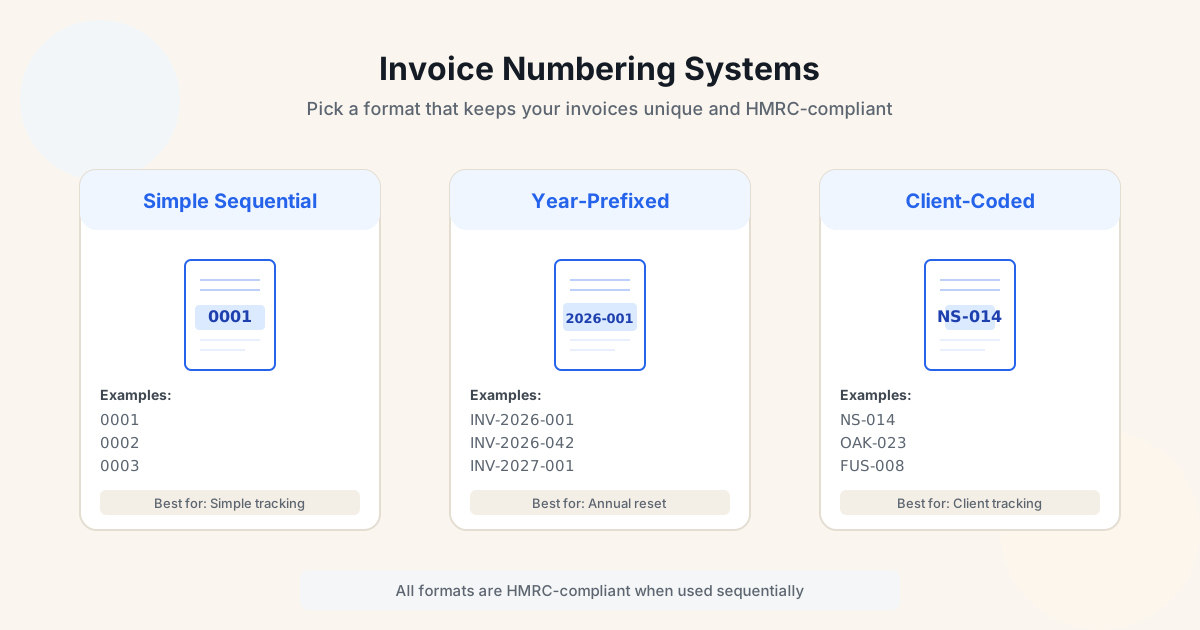
What an invoice number is (and why it matters)
An invoice number is a unique identifier you assign to each invoice you send. No two invoices should ever have the same number.
Example formats:
- Simple sequential:
0001,0002,0003 - Year-prefixed:
INV-2026-001,INV-2026-002 - Client-coded:
NS-014(Northline Studio, invoice 14) - Date-based:
20261007-01(7 October 2026, first invoice)
Why invoice numbers matter
✓ Payment matching — When a client pays you, they reference the invoice number. You can instantly match the payment to the right invoice.
✓ Dispute resolution — If a client says "I already paid that," the invoice number proves which transaction you are discussing.
✓ Audit trail — HMRC expects you to keep records that link invoices to income. Unique invoice numbers make this possible.
✓ Professional credibility — A clear invoice number tells clients you run your business properly. It builds trust.
✓ Avoiding duplication — Without a system, you will eventually reuse a number. That causes confusion and can trigger HMRC questions.
Bottom line: An invoice number is not optional decoration. It is a legal requirement, a payment tracking tool, and a bookkeeping foundation.
Are invoice numbers required by UK law? (GOV.UK and HMRC rules)
Yes. Invoice numbers are legally required in the UK.
GOV.UK requirement (all businesses)
GOV.UK states that every invoice must include a unique identification number.
This applies whether you are a sole trader, limited company, VAT registered or not.
Source: GOV.UK — Invoices: what they must include
HMRC VAT requirement (VAT-registered businesses)
If you are VAT registered, HMRC has a stricter rule. Your VAT invoices must have a unique sequential number that identifies the invoice.
What "sequential" means:
HMRC does not require you to use purely consecutive numbers (001, 002, 003) with no gaps. But the numbers must follow a logical sequence that you can explain.
HMRC Notice 700 (VAT guide), Section 16.3 states:
"A VAT invoice must show: a unique identifying number based on a sequential series which identifies the invoice."
This means:
✓ You can use prefixes or codes — INV-2026-001 is fine, as is CLIENT-042.
✓ You can have multiple series — One series for products, one for services, one per client. Each series must be sequential within itself.
✓ Gaps happen — If you cancel an invoice or void it, the number is gone. HMRC expects gaps when invoices are cancelled. Just keep the cancelled invoice on file.
✓ You cannot reuse numbers — Once you use INV-2026-007, it is gone forever. Even if you void that invoice, do not use 007 again.
What HMRC checks during audits:
When HMRC audits your VAT records, they trace your invoices to check you reported the right amount of VAT. Invoice numbers help them verify:
✓ Every invoice is unique
✓ You have not hidden invoices (missing numbers in the sequence can raise questions, though legitimate gaps are fine if you can explain them)
✓ You have kept proper records of voided or cancelled invoices
Source: HMRC Notice 700: VAT guide — Section 16 (Tax invoices)
If you are NOT VAT registered
You still must use a unique invoice number (GOV.UK requirement), but HMRC does not enforce the "sequential" rule unless you are VAT registered.
That said, using a sequential system is good practice even if you are not VAT registered. It keeps your bookkeeping clean and prepares you for VAT registration when your turnover crosses £90,000.
Bottom line: Invoice numbers are mandatory. If you are VAT registered, they must be sequential. If you are not VAT registered, they must still be unique.
Five invoice numbering schemes — worked examples and how to pick
Here are the most common schemes UK freelancers use, with worked examples and a decision test.
Scheme 1: Simple sequential
Format: 0001, 0002, 0003, 0004...
How it works: Start at 1 (or 0001 if you prefer leading zeros) and count up forever. Never reset.
Example:
- Invoice 0001: March 2026, Logo design for Northline Studio — £1,200
- Invoice 0002: April 2026, Website build for Oak & Pixel — £3,500
- Invoice 0003: May 2026, Retainer for Fusion Financial — £1,500
Pros:
✓ Simplest to manage — no prefixes, no codes, just count up
✓ Works for any business size
✓ Clear sequential order for HMRC
Cons:
✗ Reveals how many invoices you have sent (invoice 0007 tells the client you are new)
✗ No way to identify the client or project from the number alone
Pick this if: You want the simplest system and you do not mind clients knowing your invoice volume.
Scheme 2: Year-prefixed sequential
Format: 2026-001, 2026-002, 2026-003 or INV-2026-001, INV-2026-042
How it works: Prefix each number with the year. Reset the counter to 001 at the start of each calendar year.
Example:
- Invoice INV-2026-001: January 2026, Brand strategy for Lumen Fitness — £2,400
- Invoice INV-2026-002: January 2026, Social templates for Northline — £450
- ...
- Invoice INV-2026-085: December 2026, Web hosting support for Oak & Pixel — £150
- Invoice INV-2027-001: January 2027, New year, new sequence
Pros:
✓ Easy to see which year an invoice belongs to
✓ Resetting yearly keeps numbers short (never goes above 3 digits unless you send 1000+ invoices/year)
✓ No risk of duplicate numbers across years
Cons:
✗ Slightly more complex than pure sequential (you need to remember to reset on 1 Jan)
✗ Still reveals invoice volume within the year
Pick this if: You like clean yearly bookkeeping and you invoice more than a handful of clients per year.
Scheme 3: Client-coded
Format: NS-014, FUS-008, OAK-023 (client initials + number)
How it works: Assign a 2-4 letter code to each client. Number invoices sequentially per client.
Example:
- Invoice NS-001: Northline Studio, first invoice (logo design) — £1,200
- Invoice NS-002: Northline Studio, second invoice (business cards) — £300
- Invoice FUS-001: Fusion Financial, first invoice (strategy retainer) — £1,500
- Invoice OAK-001: Oak & Pixel, first invoice (website build) — £3,500
Pros:
✓ You can instantly see which client the invoice belongs to
✓ Clients with multiple invoices see their own sequence (professional)
✓ No need to search files — you know NS-014 is Northline's 14th invoice
Cons:
✗ More admin — you need to track the next number for each client
✗ If you have 50+ clients, managing codes gets messy
✗ HMRC might question it if your audit trail is not clear (keep a master log)
Pick this if: You work with 5-15 regular clients and you want instant client identification.
Scheme 4: Project-based
Format: PROJ-WEB-001, PROJ-LOGO-005, RET-SEP26 (project code + number or month)
How it works: Code invoices by project type or specific project name. Number sequentially within each project.
Example:
- Invoice PROJ-WEB-001: Website project for Northline, deposit — £1,400
- Invoice PROJ-WEB-002: Website project for Northline, milestone 1 — £1,400
- Invoice PROJ-WEB-003: Website project for Northline, final payment — £1,400
- Invoice PROJ-LOGO-001: Logo design for Fusion, deposit — £600
Pros:
✓ Groups invoices by project (useful for multi-invoice projects)
✓ Easy to see how many invoices a project generated
Cons:
✗ Complex to manage if you run many projects at once
✗ Harder to maintain a single sequential series for HMRC (multiple overlapping series)
✗ Clients might find the codes confusing
Pick this if: You run long projects with multiple milestone invoices and you need to track them by project, not by client.
Scheme 5: Date-based
Format: 20261007-01, 20261015-02 (YYYYMMDD-invoice number that day)
How it works: Prefix the invoice number with the date (year-month-day) and add a counter for invoices sent that day.
Example:
- Invoice 20261007-01: 7 October 2026, first invoice of the day — Northline retainer
- Invoice 20261007-02: 7 October 2026, second invoice of the day — Oak & Pixel web build
- Invoice 20261015-01: 15 October 2026, first invoice of the day — Fusion strategy
Pros:
✓ Invoice number encodes the date — no need to check the issue date field
✓ Naturally sequential by date
Cons:
✗ Long and awkward (20261007-01 is 11 characters)
✗ Confusing for clients ("Is that a date or an invoice number?")
✗ If you send multiple invoices per day, the counter restarts daily (not a true continuous sequence)
Pick this if: You send 1-2 invoices per day and you want the date embedded in the number for instant lookup.
Decision test: which scheme should you use?
Answer these questions to pick your system:
1. Do you want the simplest possible system with zero admin?
→ Use simple sequential (0001, 0002, 0003...)
2. Do you like resetting the counter each year for clean bookkeeping?
→ Use year-prefixed (INV-2026-001, INV-2026-002...)
3. Do you work with 5-15 regular clients and want to identify them instantly?
→ Use client-coded (NS-014, OAK-023...)
4. Do you run long projects with multiple milestone invoices?
→ Use project-based (PROJ-WEB-001, PROJ-WEB-002...)
5. Do you invoice multiple clients every day and want the date encoded?
→ Use date-based (20261007-01, 20261015-01...)
Most UK freelancers use year-prefixed (Scheme 2) or simple sequential (Scheme 1). Both are HMRC-compliant, simple to manage, and professional.
If you are unsure, start with INV-2026-001 and count up. You can always switch schemes later (see "Switching tools or numbering systems mid-year" below).
Invoice numbering rules — what keeps your system clean
Once you pick a scheme, follow these rules to avoid problems.
Rule 1: Never reuse a number
Bad: You send invoice 0042 in March. The client does not pay. In June, you reuse 0042 for a different client.
Why it is bad: Now you have two invoices with the same number. Your bookkeeping is broken. HMRC will flag this during an audit.
Correct: If invoice 0042 is unpaid, chase it or write it off. The number 0042 is gone forever. Your next invoice is 0043.
Rule 2: Never skip numbers on purpose (but gaps from voids are fine)
Bad: You send invoices 0010, 0011, 0012, then skip to 0020 because you like round numbers.
Why it is bad: HMRC might think you deleted invoices to hide income. Intentional gaps raise audit questions.
Correct: Count up sequentially: 0010, 0011, 0012, 0013, 0014... If you void invoice 0013, that number is gone and you have a gap. That is fine — just keep the voided invoice on file.
Exception: If you use year-prefixed numbering (2026-001) and you switch to a new year (2027-001), the "gap" between 2026-085 and 2027-001 is normal and expected.
Rule 3: Letters and prefixes are fine
Good: INV-2026-042, NS-014, PROJ-WEB-003
HMRC does not require numbers-only. As long as the scheme is sequential and unique, you can use letters, hyphens, and prefixes.
Rule 4: Do not restart at 1 if it creates duplicate numbers
Bad: You use simple sequential (0001, 0002, 0003...). On 1 January 2027, you restart at 0001.
Why it is bad: Now you have two invoice 0001s — one from 2026, one from 2027. Duplication.
Correct: Either keep counting forever (0001, 0002, ... 0085, 0086...) or use year-prefixed numbering (2026-001, 2027-001) so the year makes each number unique.
Rule 5: You can start at any number, as long as you continue sequentially
Myth: "I must start at 0001."
Truth: You can start at 1000 if you want to hide how new you are. As long as you count up from there (1000, 1001, 1002...), it is fine.
Why freelancers do this: Starting at 1000 makes you look more established than starting at 0001.
HMRC does not care where you start. They care that the sequence is unique and continuous.
Rule 6: If you have two businesses, use separate sequences
If you run two businesses (e.g. a design studio and a consulting practice), use separate invoice sequences for each.
Option 1: Prefix them differently
- Studio:
STUDIO-2026-001,STUDIO-2026-002 - Consulting:
CONSULT-2026-001,CONSULT-2026-002
Option 2: Keep separate numbering systems
- Studio: Simple sequential starting at 1000
- Consulting: Year-prefixed starting at 2026-001
Why this matters: If both businesses are VAT registered, HMRC expects separate VAT records and separate invoice sequences.
What to do when things go wrong
Even with a clean system, mistakes happen. Here is how to fix them without breaking HMRC rules.
You cancelled an invoice (client did not proceed)
What to do:
- Void the invoice — Mark it as "VOID" or "CANCELLED" in your records
- Keep the file — Do not delete it. HMRC expects you to keep voided invoices.
- Do not reuse the number — If you voided invoice 0042, the next invoice is 0043.
- Issue a credit note if it was already paid — If the client paid and you need to refund, issue a credit note (see credit note template UK)
Example:
You sent invoice INV-2026-042 for a logo project. The client cancelled before you started. You void INV-2026-042 and keep the voided PDF in your records. Your next invoice is INV-2026-043.
You sent a duplicate number by mistake
What to do:
- Identify which invoice is wrong
- Cancel the incorrect invoice and mark it void
- Reissue the correct invoice with a new unique number
- Notify the client immediately — "Apologies, I sent invoice 0042 twice. Please ignore the second one. The correct invoice is 0043."
Example:
You sent invoice 0042 to Northline in March. In June, you accidentally sent another invoice 0042 to Fusion. You void the June invoice and reissue it as 0043.
You switched invoicing tools mid-year
What to do:
- Check the last invoice number you used in your old tool
- Continue the sequence in your new tool
Example:
You used Excel until September 2026. Your last invoice was INV-2026-085. You switch to invoicing software in October. Your first software invoice is INV-2026-086.
Common mistake: New software often starts at 0001 by default. Override this and set the starting number to match your last invoice + 1.
You have gaps in your sequence (voided invoices)
What HMRC expects:
Gaps are fine if they are caused by voided or cancelled invoices. HMRC expects gaps. What they do NOT expect is missing invoices that you cannot explain.
What to keep:
✓ The voided invoice PDF or record
✓ A note explaining why it was voided (client cancelled, duplicate, error)
✓ A credit note if the invoice was already paid
Example gap sequence:
- Invoice 0040: Paid
- Invoice 0041: Paid
- Invoice 0042: Voided (client cancelled project)
- Invoice 0043: Paid
This is clean and audit-proof.
You have two separate credit note sequences
Best practice: Use a separate sequence for credit notes.
Example:
- Invoice sequence:
INV-2026-001,INV-2026-002,INV-2026-003 - Credit note sequence:
CN-2026-001,CN-2026-002,CN-2026-003
This keeps invoices and credit notes separate and makes bookkeeping cleaner.
HMRC allows this. Each sequence (invoices, credit notes) must be sequential within itself.
For credit note templates, see credit note template UK.
Invoice number vs PO number vs order number vs payment reference
These are NOT the same. Here is what each means.
Invoice number
Your unique identifier for the invoice you send.
Set by: You
Example: INV-2026-042
Where it appears: On your invoice (required field)
PO number (Purchase Order number)
The client's reference for their internal purchase approval.
Set by: The client
Example: PO-45892, ORDER-2026-0312
Where it appears: The client gives it to you. You include it on your invoice (if they provide one).
Why it matters: Larger companies and public sector organisations require a PO number on your invoice. Without it, their finance team cannot process payment.
What to do: Always ask corporate clients "Do you have a PO number for this invoice?" before you send it. Include the PO number in a separate field on your invoice, like this:
Invoice number: INV-2026-042
Your PO number: PO-45892
Order number
Similar to a PO number. Some clients call it an "order number" or "reference number." Same rule: include it on your invoice if they provide one.
Payment reference
The reference the client puts in the bank transfer when they pay you.
Best practice: Ask the client to use your invoice number as the payment reference.
Example on your invoice:
Payment details
Sort code: 20-48-74
Account number: 12345678
Reference: INV-2026-042
This makes it easy to match incoming payments to invoices.
HMRC record-keeping requirements — how long to keep invoice records
HMRC requires you to keep invoice records for a minimum period, depending on your business structure.
Sole traders (Self Assessment)
Keep records for at least 5 years after the 31 January Self Assessment deadline for the relevant tax year.
Example:
- You send invoice INV-2026-042 on 7 October 2026 (tax year 2026/27).
- The Self Assessment deadline for 2026/27 is 31 January 2028.
- You must keep invoice 042 until at least 31 January 2033 (5 years after the deadline).
What to keep:
✓ All invoices sent (including voided ones)
✓ A record of payments received
✓ Bank statements showing payments
✓ A log or spreadsheet linking invoices to income
Source: GOV.UK — Self Assessment: keeping records
Limited companies
Keep records for at least 6 years from the end of the financial year they relate to.
Example:
- Your company year ends 31 March 2026.
- You must keep all 2025/26 records until at least 31 March 2032 (6 years).
What to keep:
✓ All invoices and credit notes
✓ Bank statements
✓ VAT records (if VAT registered)
✓ Annual accounts and Corporation Tax returns
Source: GOV.UK — Running a limited company: company records
VAT-registered businesses
If you are VAT registered, you must keep VAT records (including invoices) for at least 6 years.
Source: GOV.UK — VAT record keeping
Bottom line: Keep your invoices for at least 6 years to be safe, regardless of business structure. Digital copies (PDF) are fine — you do not need to keep paper.
Copy-paste invoice log (track every invoice in one place)
A simple spreadsheet log helps you track invoices, spot unpaid ones, and prepare for HMRC audits.
Copy this table into Google Sheets or Excel and fill it in every time you send an invoice.
| Invoice No. | Date Sent | Client Name | Project / Description | Net Amount (£) | VAT (£) | Gross Total (£) | Due Date | Status | Date Paid | Notes |
|---|---|---|---|---|---|---|---|---|---|---|
| INV-2026-001 | 2026-01-10 | Northline Studio | Logo design | 1,000.00 | 200.00 | 1,200.00 | 2026-01-24 | Paid | 2026-01-22 | |
| INV-2026-002 | 2026-01-15 | Oak & Pixel | Website build deposit | 1,400.00 | 280.00 | 1,680.00 | 2026-01-29 | Paid | 2026-01-28 | |
| INV-2026-003 | 2026-02-01 | Fusion Financial | Strategy retainer Feb | 1,500.00 | 300.00 | 1,800.00 | 2026-02-15 | Overdue | Chased 2026-02-18 | |
| INV-2026-004 | 2026-02-10 | Lumen Fitness | Social templates | 450.00 | 90.00 | 540.00 | 2026-02-24 | Void | Client cancelled |
Column explanations
- Invoice No. — Your unique invoice number
- Date Sent — When you sent the invoice (YYYY-MM-DD format for easy sorting)
- Client Name — Who you invoiced
- Project / Description — Brief description (helps you remember what it was for)
- Net Amount — Pre-VAT amount
- VAT — VAT charged (if applicable)
- Gross Total — Total the client owes (Net + VAT)
- Due Date — Payment deadline (e.g. 14 days after Date Sent)
- Status —
Sent,Paid,Overdue,Void,Part-paid - Date Paid — When the payment cleared in your bank
- Notes — Any relevant notes (chased, credit note issued, etc.)
How to use it
✓ Add a row every time you send an invoice
✓ Update the Status and Date Paid columns when payment arrives
✓ Mark voided invoices as Void and note why in the Notes column
✓ Filter by Status = Overdue to see which invoices need chasing (see how to chase a late invoice)
✓ Keep this file backed up (Google Sheets auto-saves; Excel should be on cloud storage)
This log is your audit trail. If HMRC asks "Show me invoice 042," you can find it instantly.
Set up your invoice numbering system in 10 minutes
Use this checklist to build a system that never breaks.
Step 1: Pick your numbering scheme (2 minutes)
Choose one:
- Simple sequential (
0001,0002,0003...) - Year-prefixed (
INV-2026-001,INV-2026-002...) - Client-coded (
NS-014,OAK-023...)
Recommended for most freelancers: Year-prefixed (INV-2026-001).
Step 2: Decide your starting number (1 minute)
- If you are brand new: Start at
INV-2026-001(or0001if simple sequential) - If you already have invoices: Check your last invoice number and continue from there
- If you want to look established: Start at
1000or2026-100
Step 3: Set up your invoice template (3 minutes)
Add the invoice number field to your template (Word, Excel, Google Docs, or invoicing software).
Where to put it:
Place the invoice number near the top of the invoice, below your business name and above the client details.
Example invoice header:
[Your Business Name]
[Address]
[Email]

Invoice Number: INV-2026-042
Invoice Date: 7 October 2026
Due Date: 21 October 2026

Bill to:
[Client Name]
[Client Address]
For full invoice templates, see freelance invoice template examples.
Step 4: Set up your invoice log (3 minutes)
Copy the table above into Google Sheets or Excel.
Save it as Invoice Log 2026.xlsx or similar.
Every time you send an invoice, add a row.
Step 5: Write down your numbering rule (1 minute)
Open a note (Apple Notes, Notion, Google Doc) and write:
"Invoice numbering system: Year-prefixed (INV-YYYY-NNN). Starting number: INV-2026-001. Never reuse numbers. Voided invoices stay in the sequence. Reset to 001 every 1 January."
Save this as Invoice Numbering Rule.txt in the same folder as your invoice log.
Why this matters: If you forget your system or someone else handles your invoicing, they can read the rule and continue correctly.
Worked example: moving from ad-hoc to a clean system
Here is how a UK freelance developer cleans up their invoice numbering mid-year.
Scenario
Freelancer: Alex at Oak & Pixel
Problem: Alex has been using random invoice numbers (Invoice-March, Invoice-2, Oak_Invoice_Final) with no system. Clients are confused. Alex's accountant is annoyed.
Date: October 2026
Solution: Switch to year-prefixed numbering without breaking the sequence.
Step 1: List all invoices sent so far in 2026
Alex lists every invoice sent this year:
- Invoice-Jan (sent 15 Jan 2026)
- Invoice-2 (sent 3 Feb 2026)
- Oak_Invoice_Final (sent 18 Mar 2026)
- Invoice-April (sent 10 Apr 2026)
- INV-May (sent 5 May 2026)
- Invoice-June-v2 (sent 20 Jun 2026)
- Invoice-July (sent 8 Jul 2026)
- Invoice-Aug (sent 12 Aug 2026)
- Invoice-Sept (sent 5 Sep 2026)
Total invoices sent: 9
Step 2: Assign clean sequential numbers retroactively
Alex renames the invoices in their records (does not resend them to clients, just updates the log):
- Invoice-Jan →
INV-2026-001 - Invoice-2 →
INV-2026-002 - Oak_Invoice_Final →
INV-2026-003 - Invoice-April →
INV-2026-004 - INV-May →
INV-2026-005 - Invoice-June-v2 →
INV-2026-006 - Invoice-July →
INV-2026-007 - Invoice-Aug →
INV-2026-008 - Invoice-Sept →
INV-2026-009
Alex updates the invoice log to reflect these numbers.
Note: The clients still have the original messy invoice numbers. That is fine — Alex's internal records are now clean. Future invoices will use the new system.
Step 3: Send the next invoice with the new system
Alex sends an invoice on 7 October 2026. The number is INV-2026-010.
The client receives a clean, professional invoice number. No confusion.
Step 4: Continue the sequence
From now on, Alex uses INV-2026-NNN for the rest of 2026, and resets to INV-2027-001 on 1 January 2027.
Total time to fix: 20 minutes (list old invoices, update log, set starting number in invoicing tool).
Invoice numbering and SoloPad
SoloPad auto-numbers invoices using your chosen format (simple sequential or year-prefixed). You set the starting number once, and SoloPad counts up automatically.
Features:
✓ Auto-increment invoice numbers (never reuse, never skip)
✓ Separate sequences for invoices and credit notes
✓ Invoice log built in (tracks sent/paid/overdue automatically)
✓ Export invoice log as CSV for your accountant
✓ Void invoices without breaking the sequence
Pricing: Starter £5/month, Solo £12/month, Pro £29/month.
Questions? info@solopad.io
This is a short optional mention — you do not need invoicing software to implement the systems in this guide. A spreadsheet and a template work fine.
FAQ
Can I change my invoice numbering system mid-year?
Yes, but keep the sequence continuous. If your last invoice was 042, your first invoice in the new system should be 043 (or INV-2026-043 if you are adding a prefix). Do not restart at 001 unless you add a prefix that makes the number unique (e.g. 2026-001).
What if my client asks me to use their invoice number format?
Politely decline. Your invoice number is your unique identifier for your records and HMRC compliance. The client can use their PO number for their internal tracking. Include their PO number on your invoice, but keep your own invoice number intact.
Do HMRC actually check invoice numbers during audits?
Yes. HMRC traces invoices during VAT audits and Self Assessment enquiries. Missing invoices, duplicate numbers, or unexplained gaps raise red flags. Keep clean records and you will have no problems.
Should I include the invoice number in the file name?
Yes. Name your PDF files like INV-2026-042_Northline_Studio.pdf or Invoice_INV-2026-042.pdf. This makes it easy to find invoices in your file system and proves you sent the correct invoice if a client disputes it.
Can I have separate invoice sequences for different services?
Yes, but only if each sequence is clearly identifiable and sequential within itself. For example:
- Design invoices:
DESIGN-2026-001,DESIGN-2026-002 - Consulting invoices:
CONSULT-2026-001,CONSULT-2026-002
This is HMRC-compliant as long as you keep separate logs for each sequence. However, for most freelancers, one universal sequence is simpler.
What happens if I accidentally send the same invoice number twice?
Cancel one of the invoices immediately and reissue it with a new unique number. Notify the client: "Apologies, invoice 042 was sent twice by mistake. Please use invoice 043 instead. Invoice 042 is cancelled." Keep the cancelled invoice on file for your records.
Related guides
Invoice numbers are one piece of getting paid on time. For the full picture, see:
- Freelance invoice template examples — Copy-paste UK invoice templates with GBP, VAT, and sort code
- Invoice payment terms UK — Net 14, Net 30, due dates, and late payment rights
- How to chase a late invoice — Email scripts, statutory interest, and legal options
- Credit note template UK — How to issue a credit note when you need to refund or cancel
- Statement of account template UK — Track multiple unpaid invoices for one client
- Statutory interest UK freelancers — Your rights under the Late Payment of Commercial Debts (Interest) Act 1998
- When to register for VAT UK freelancers — The £90,000 threshold and when to register
- Proforma invoice template UK — Quote-style invoices before the work is done
Sources and references
This guide was written using the following official UK sources and keyword research:
- GOV.UK — Invoices: what they must include — Legal requirement for unique invoice numbers
- HMRC Notice 700: VAT guide — Section 16 (Tax invoices) — VAT invoice requirements including sequential numbering
- GOV.UK — Self Assessment: keeping records — 5-year record-keeping requirement for sole traders
- GOV.UK — Running a limited company: company records — 6-year record-keeping requirement for limited companies
- GOV.UK — VAT record keeping — VAT record retention requirements
- Ubersuggest UK keyword data (location ID 2826, 7 October 2026): "invoice number" (720/mo, SD 23), "invoice numbering" (880/mo, SD 48), "what is an invoice number" (390/mo, SD 23), "generate invoice number" (140/mo, SD 30), "example of invoice number" (110/mo, SD 30), "how to generate invoice number" (110/mo, SD 42), "invoice number generator" (90/mo, SD 8), "how do you create an invoice number" (90/mo, SD 24), "vat invoice number" (90/mo, SD 38), "unique invoice number" (50/mo, SD 36), "is invoice number same as order number" (50/mo, SD 16), "can invoice number have letters" (20/mo, SD 6), "does an invoice need an invoice number" (20/mo, SD 8)
- Google Trends UK (12 months to October 2026): "invoice number" average interest 69, rising trend, peak June 2026
Method note:
SERP competitors reviewed (not copied): SumUp invoice dictionary page, Which? Trusted Traders invoicing guide, QuickBooks UK invoice guide, Adobe invoicing basics, GOV.UK invoice requirements, Wise (Australian page), Stripe invoice guide, TreviPay, small invoice generators, online invoice templates.
None of these sources provide a UK freelancer with:
✓ A clear decision test for picking a numbering scheme
✓ Worked examples of all 5 common schemes
✓ HMRC VAT Notice 700 guidance on sequential numbers and multiple series
✓ What to do when you void/cancel invoices or switch tools mid-year
✓ Record-keeping periods (5 years for sole traders, 6 years for limited companies)
✓ A copy-paste invoice log
✓ Invoice number vs PO number vs payment reference clarification
All content, examples, decision tests, worked scenarios, and invoice log template are original SoloPad editorial content. Invented studio names (Oak & Pixel, Northline Studio, Fusion Financial, Lumen Fitness) used in examples.
This article is for general education. It is not legal, tax, or accounting advice. HMRC rules, VAT requirements, and record-keeping obligations may vary by business structure, jurisdiction, and specific circumstances. When in doubt, consult an accountant or HMRC directly.